


What Is Hopecore Music — And Why Does It Make Every Video Feel Like a Turning Point?
You know the feeling.
A video starts playing and within the first three seconds — before a single word has appeared on screen — something shifts. The music alone does it. There's a softness to it, a warmth, a gentle upward momentum that feels like sunlight coming through a window after a long gray week.
That's hopecore music. And it's not just a soundtrack. It's the emotional engine behind some of the most-watched, most-saved, most-shared videos on TikTok, Instagram Reels, and YouTube Shorts right now.
If you've ever wondered what makes certain videos feel so different — why they stop you mid-scroll and leave you sitting with a feeling you can't quite name — the music is usually the answer. Here's everything you need to know about hopecore music, why it works so powerfully, and how to use it to make videos that genuinely move people.
What Is Hopecore Music?
Hopecore music is a loose but recognizable sonic aesthetic built around one core emotional goal: making the listener feel like things are going to be okay.
It's not a single genre. It's a feeling — translated into sound.
At its core, hopecore music tends to be soft, melodic, and emotionally open. It creates space rather than filling it. It moves with the listener rather than demanding attention. And it carries an underlying sense of forward motion — a gentle but unmistakable suggestion that even in difficulty, something good is possible.
The most recognizable characteristics of hopecore music include piano-led melodies that feel both nostalgic and present, soft acoustic guitar that creates warmth without weight, ambient textures that feel like breathing room, gentle builds that swell at emotionally significant moments, and tempos that are unhurried — slow enough to feel peaceful, moving enough to feel hopeful rather than melancholic.
What hopecore music is not: aggressive, urgent, ironic, or attention-grabbing in the way that most commercial music is designed to be. It doesn't compete with the visuals or the message — it carries them.
Why Music Is the Most Important Element of a Hopecore Video
Every creator who has made a great hopecore video will tell you the same thing: the music came first.
Not as an afterthought. Not as background. As the foundation — the emotional blueprint that every other creative decision builds around.
Here's why music holds that much power in short-form video:
Sound bypasses the analytical brain in a way visuals simply can't. When you see something, you process it — you evaluate it, contextualize it, decide how to feel about it. When you hear something, especially music, the emotional response happens before the conscious mind catches up. You feel it before you understand it.
This is why the right hopecore track can make an ordinary photo of a quiet morning feel like a profound meditation on gratitude. The music tells your nervous system how to interpret the visual before your brain has a chance to decide.
It's also why the wrong music ruins a video that should have been perfect. Beautiful footage, meaningful words, careful color grading — all of it collapses if the track doesn't match the emotional intention. Music isn't decoration. It's the container that holds everything else.
For hopecore specifically, the music does three jobs simultaneously: it signals safety (this is a space where you're allowed to feel), it creates emotional momentum (something is building, something is shifting), and it provides resolution (by the end, there's a feeling of having arrived somewhere better than where you started).
When all three of those things happen in 30–60 seconds, viewers don't just watch the video. They experience it. And experiences get saved, shared, and returned to.
The Sounds That Define the Hopecore Aesthetic
While hopecore music isn't tied to a single genre, certain sounds have become so associated with the aesthetic that they've become a visual shorthand — you hear them and you know what kind of video you're in.
Solo piano. Clean, unhurried, slightly resonant. Often with a melody that feels familiar even the first time you hear it — like something half-remembered from a dream. Piano-driven hopecore tracks are among the most reliably emotional in the format because the instrument itself carries connotations of intimacy and sincerity.
Acoustic guitar with soft production. Warm, gentle, slightly imperfect in the way live instruments always are. This imperfection is part of what makes it feel human rather than manufactured — and human is exactly what hopecore content needs to feel.
Ambient pads and textures. Soft layers of sound that don't demand attention but create a sense of depth and space. These are often what give hopecore tracks their characteristic feeling of breathing room — like the music itself is exhaling.
Gentle strings. Violin or cello played softly, often used in the build sections of hopecore tracks to create emotional momentum without becoming dramatic. When strings arrive in a hopecore video at exactly the right moment, the effect can be genuinely overwhelming in the best possible way.
Vocal samples and whispered lyrics. Not prominent lead vocals, but soft, sometimes wordless voices woven into the production. They add human warmth without the distraction of lyrics that need to be consciously processed.
The build. Perhaps the most important structural element — the moment when the music shifts from quiet and contained to open and expansive. In the best hopecore videos, this build is timed to coincide with the emotional peak of the visual content, creating a synchronization that hits like a physical sensation.
How Hopecore Music Drives Viral Performance
The connection between hopecore music and viral performance isn't accidental — it's the direct result of how these tracks interact with viewer behavior and platform algorithms.
Completion rates. Hopecore tracks are structured to create a sense of incompleteness until the build resolves. Viewers who start watching stay watching because the music creates a subconscious expectation of arrival — a feeling of something about to happen. This drives completion rates through the roof, which is the single most important metric for algorithmic distribution on TikTok and Reels.
Rewatches. Emotionally satisfying content gets rewatched. When the music creates a feeling the viewer wants to experience again — that warmth, that release, that sense of things being okay — they watch a second time. And a third. Each rewatch signals to the algorithm that the content has exceptional value.
Saves. People save hopecore videos to come back to on hard days. "I need this for when I'm struggling" is one of the most powerful save motivations in any content category. Save rate is a strong algorithmic signal across every platform, and hopecore music's emotional staying power drives it higher than almost any other style.
Shares. The impulse to share hopecore content is almost reflexive — "I need to send this to my friend who's going through something." That organic distribution is worth more than any paid amplification and creates the kind of viral spread that feels genuine because it is.

Finding the Right Hopecore Music for Your Videos
This is where most creators get stuck. They know what hopecore music should feel like. They know the effect they're trying to create. But finding the actual tracks — ones that are high quality, match the specific mood of their content, and are cleared for use without copyright issues — can eat hours.
There's the endless scroll through royalty-free music sites where nothing quite feels right. The risk of using a popular song and getting muted or demonetized. The frustration of finding the perfect track and realizing it's not licensed for commercial use.
The HOPECORE app solves all of this with a single curated library built specifically for this aesthetic. Every track has been hand-selected for its emotional resonance, its compatibility with the hopecore visual style, and its ability to elevate the content it's paired with. And every track is fully licensed — no copyright concerns, no strikes, no muted videos.
More importantly, the app doesn't just give you music to choose from. Its AI matches your specific content to the track most likely to amplify its emotional impact. It analyzes the mood, pacing, and visual content of your footage and suggests tracks that will work with what you've made — not just tracks that are generally nice.
The difference between manually hunting for music and having the right track found for you is the difference between an hour of frustration and a finished video in five minutes.
How to Add Hopecore Music to Your Videos With the HOPECORE App
Ready to create content that sounds as good as it looks? Here's exactly how the HOPECORE app handles music for your videos:
Step 1: Download HopeCORE FreeAvailable on iOS (App Store) and Android (Google Play). Free to download and ready in under a minute.
Step 2: Upload Your Photos or ClipsSelect content from your camera roll — any footage, any style. The AI works with whatever you give it. You don't need cinematic material to create cinematic-feeling results.
Step 3: Let the AI Analyze Your ContentHopeCORE reads the emotional content of your footage — the mood, the lighting, the pacing — and uses that analysis to guide every creative decision, including music selection.
Step 4: Browse and Select Your TrackExplore the curated hopecore music library, filtered by mood: peaceful, uplifting, reflective, triumphant, gentle, bittersweet. Every track has been chosen for its ability to carry the emotional weight that hopecore content requires. Select the one that resonates and the app auto-syncs your visuals to the rhythm — no manual timing required.
Step 5: Fine-Tune If NeededWant the build to hit at a specific moment? Adjust the sync point with a single tap. The app gives you control without requiring technical knowledge to use it.
Step 6: Add Visuals, Text, and AestheticLayer in color grading, text overlays, and the signature hopecore aesthetic — all with one-tap simplicity.
Step 7: Export for Every PlatformYour finished video exports automatically optimized for TikTok, Instagram Reels, and YouTube Shorts — the right dimensions, the right format, ready to post.
Hopecore Music and Emotional Storytelling — Why They're Inseparable
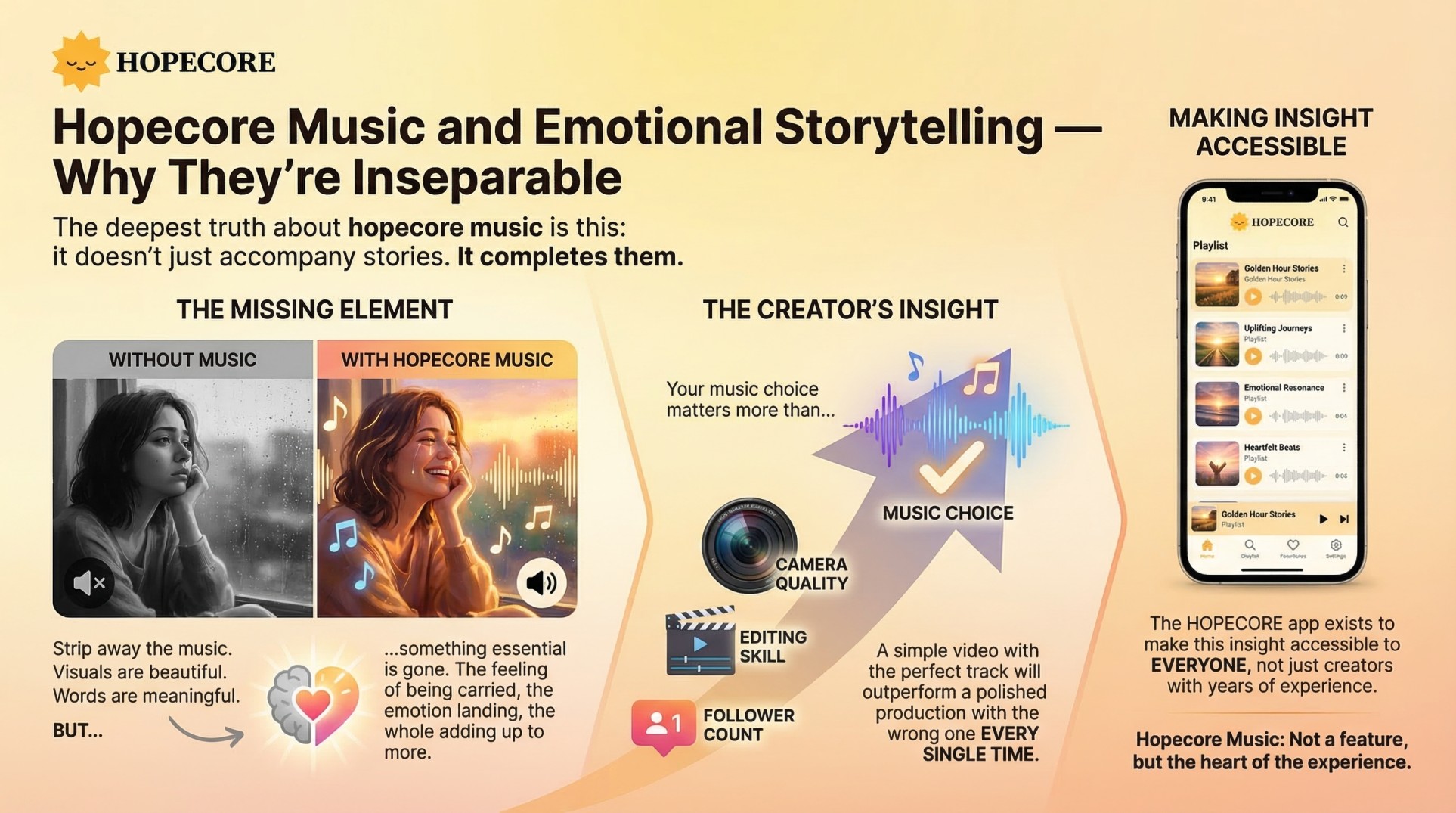
The deepest truth about hopecore music is this: it doesn't just accompany stories. It completes them.
Think about the last hopecore video that really moved you. Strip away the music and replay it in your mind with silence. The visuals are still beautiful. The words are still meaningful. But something essential is gone — the feeling of being carried, of the emotion having somewhere to land, of the whole thing adding up to more than the sum of its parts.
That's what the right music does. It's not a feature of a great hopecore video — it's what makes a collection of clips and words into something that feels like an experience.
For creators who want to make content that genuinely reaches people, this is the most important technical insight available: your music choice matters more than your camera quality, your editing skill, or your follower count. A simple video with the perfect track will outperform a polished production with the wrong one every single time.
The HOPECORE app exists, in part, to make sure that insight is accessible to everyone — not just the creators who have spent years developing an ear for what works.
Start Making Videos With the Perfect Hopecore Soundtrack
The music that makes people exhale. The track that turns ordinary footage into something that feels like a gift. The sound that makes someone stop scrolling and just — feel something good for a moment.
That's what hopecore music does. And with HopeCORE, finding it and building a video around it has never been simpler.
Download HopeCORE.VIDEO free today on the App Store or Google Play. Bring your footage, your story, your message — and let the music carry it somewhere it couldn't go alone.
Frequently Asked Questions
What is hopecore music?Hopecore music is a sonic aesthetic built around creating feelings of hope, comfort, and gentle optimism. It typically features soft piano, acoustic guitar, ambient textures, and gentle builds — music that feels warm, unhurried, and emotionally open. It's most commonly used in hopecore-style short-form videos on TikTok, Instagram Reels, and YouTube Shorts.
What genre is hopecore music?Hopecore music isn't a single genre — it's an emotional aesthetic that draws from ambient, acoustic, lo-fi, and cinematic music. What unites it is the feeling it creates: soft, warm, hopeful, and safe. Tracks that achieve that feeling — regardless of genre — qualify as hopecore music.
Where can I find hopecore music for my videos?The HOPECORE app includes a curated library of fully licensed hopecore music tracks, organized by mood and automatically matched to your video content by AI. It's the easiest way to find the right track without hours of searching or risk of copyright issues.
Can I use hopecore music on TikTok without copyright issues?Copyright can be a significant issue when using popular songs on TikTok and Instagram. The HOPECORE app's music library consists entirely of fully licensed tracks cleared for use on all platforms — so you never have to worry about your video being muted, taken down, or demonetized.
Why does hopecore music make videos perform better?Hopecore music drives higher completion rates, rewatch rates, and save rates — all of which are key algorithmic signals on TikTok, Instagram Reels, and YouTube Shorts. It achieves this by creating emotional momentum that keeps viewers watching and a feeling of resolution that makes them want to save and share the video. Music that makes people feel something genuinely good is one of the most reliable viral performance drivers in short-form content.